.png)
One of Latin America's largest electricity companies operates across hydroelectric generation and high-voltage transmission, with multiple subsidiaries spanning Brazil's key energy-producing regions. With close to R 50 billion in annual gross revenue and operations concentrated across half a dozen states, the company engages with a complex ecosystem of federal and state regulators, legislators, energy associations, and public authorities.
Following its privatisation, the company faced a step-change in the complexity of its external environment. The Institutional Relations (IR) team needed to monitor over twenty active legislative projects and provisional measures across energy policy, while simultaneously managing stakeholder relationships spanning federal ministries, state legislatures, the national energy regulator, and the company's own subsidiaries.
In parallel, the Risk function was tasked by the board with building a structured capability to analyse external factors from regulatory shifts and supply chain vulnerabilities to extreme weather events that could affect operations. Neither function had a centralised system to support this work.
The company's external-facing teams faced distinct but interconnected structural gaps:
• The IR team had previously relied on a local legislative monitoring platform that offered static stakeholder profiles with no dynamic maps, connections, or cross-referencing of themes, forcing the team to manually print and update maps with no insight into relationships or positioning.
• Approximately 400 stakeholders across federal, state, and subsidiary levels lacked consistent profiling, with engagement records scattered between internal spreadsheets, the compliance platform, and an external political consultancy.
• Legislative monitoring was fragmented: the internal team tracked some projects, the external consultancy provided a weekly risk matrix, and neither feed was connected to stakeholder intelligence or media monitoring, making it difficult to identify strategic engagement opportunities around active legislation.
• The Risk team lacked any structured tool for monitoring emerging external factors from energy market shifts and regulatory changes to data centre expansion, environmental licensing, and extreme climate events.
• Cross-functional visibility was minimal: the IR team, the Risk team, and the subsidiary-facing teams each operated from different cities with separate information sources and no shared institutional memory.
TSC.ai configured Genie to serve two distinct but interconnected functions. For Institutional Relations, the platform became a legislative tracking and stakeholder intelligence hub. Each active legislative project and provisional measure was set up as a monitored project, with mapped stakeholders, linked media coverage, and AI-powered analysis of positioning and strategic gaps.
For the Risk team, the same infrastructure was adapted for emerging risk monitoring, scanning for market shifts, regulatory changes, supply chain vulnerabilities, and environmental events across the country's energy landscape.
A shared newsletter, curated dashboards, and engagement documentation through touchpoint tracking provided the connective tissue between the two functions and fed directly into compliance reporting.
The Institutional Relations team needed to monitor over twenty active legislative projects and provisional measures simultaneously, covering issues from energy storage and offshore wind to clean energy certification, data centres, and dam safety. The team relied on a weekly risk matrix from an external political consultancy, which classified each project by impact and probability of approval, but this information existed outside the company's stakeholder intelligence system. There was no way to see, in one view, which legislators were involved in a given project, what media coverage was developing around it, or where engagement efforts should be directed.
Each legislative project was set up as a monitored project in Genie, with mapped stakeholders, linked news articles, and issue-specific dashboards. The system enabled the team to overlay the consultancy's risk classifications with Genie’s stakeholder and media intelligence - identifying not just which projects were likely to advance, but who the key decision-makers were and what positions they held.
AI-powered analysis provided strategic gap assessments, flagging where the company lacked engagement on high-impact legislation. The team is now restructuring projects around macro-themes - such as energy storage, clean energy certification, and environmental licensing - to create a broader strategic view that connects individual projects, decrees, and regulatory consultations under unified intelligence frameworks.
"The quality and organisation of the report is excellent - it is strategic material for monitoring and analysing our institutional contacts." - Senior member of the Institutional Relations team - on the Touchpoints/Engagement Report
The company's multi-subsidiary structure meant that stakeholder relationships with federal and state authorities were managed independently across four major operating subsidiaries, with no shared view of who was engaging whom. The previous system offered static profiles that required manual updates and could not visualise connections between stakeholders, nor their positioning on issues relevant to the company. When preparing for meetings with subsidiary directors or public authorities, the IR team had to assemble briefing materials from scratch.
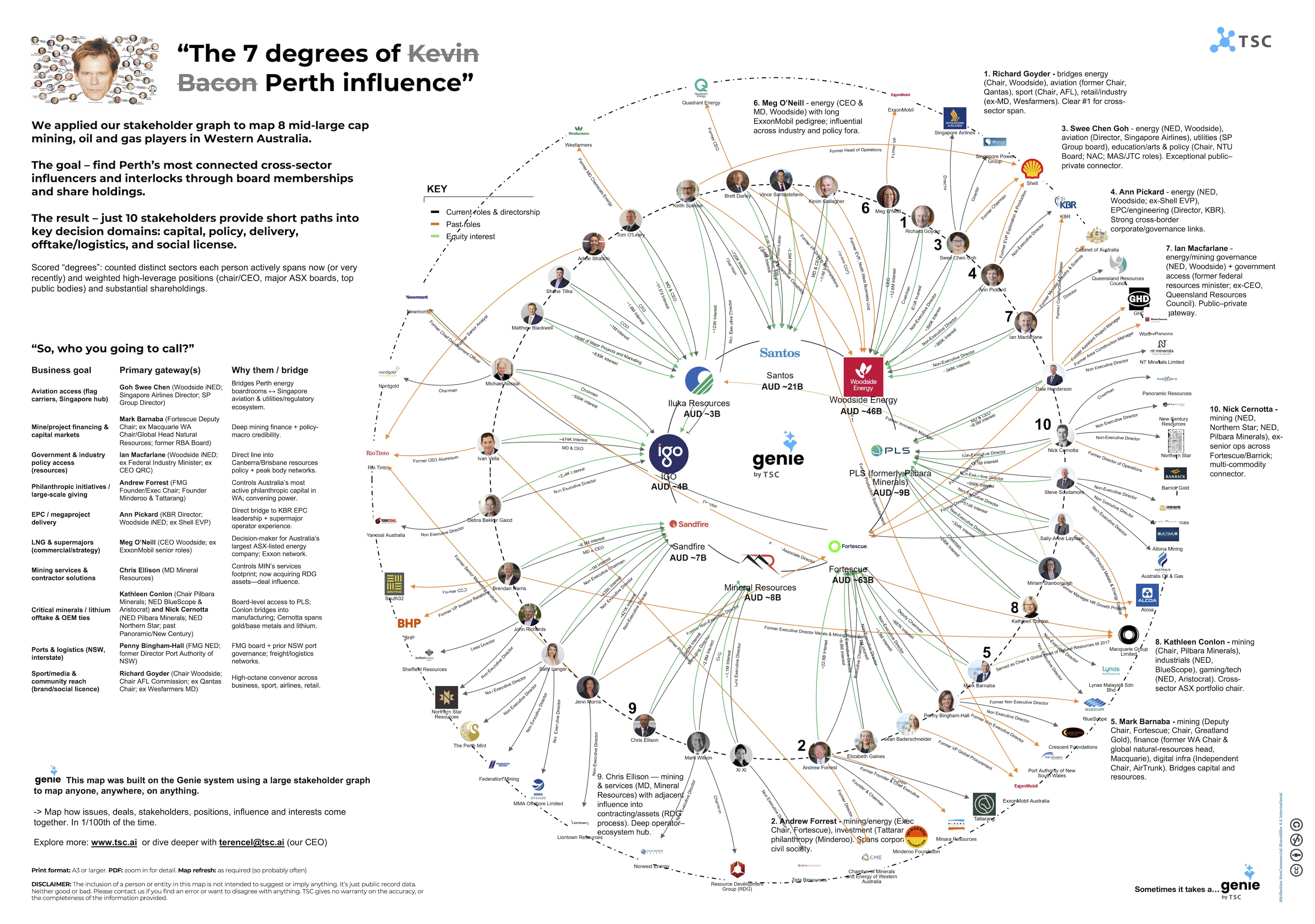
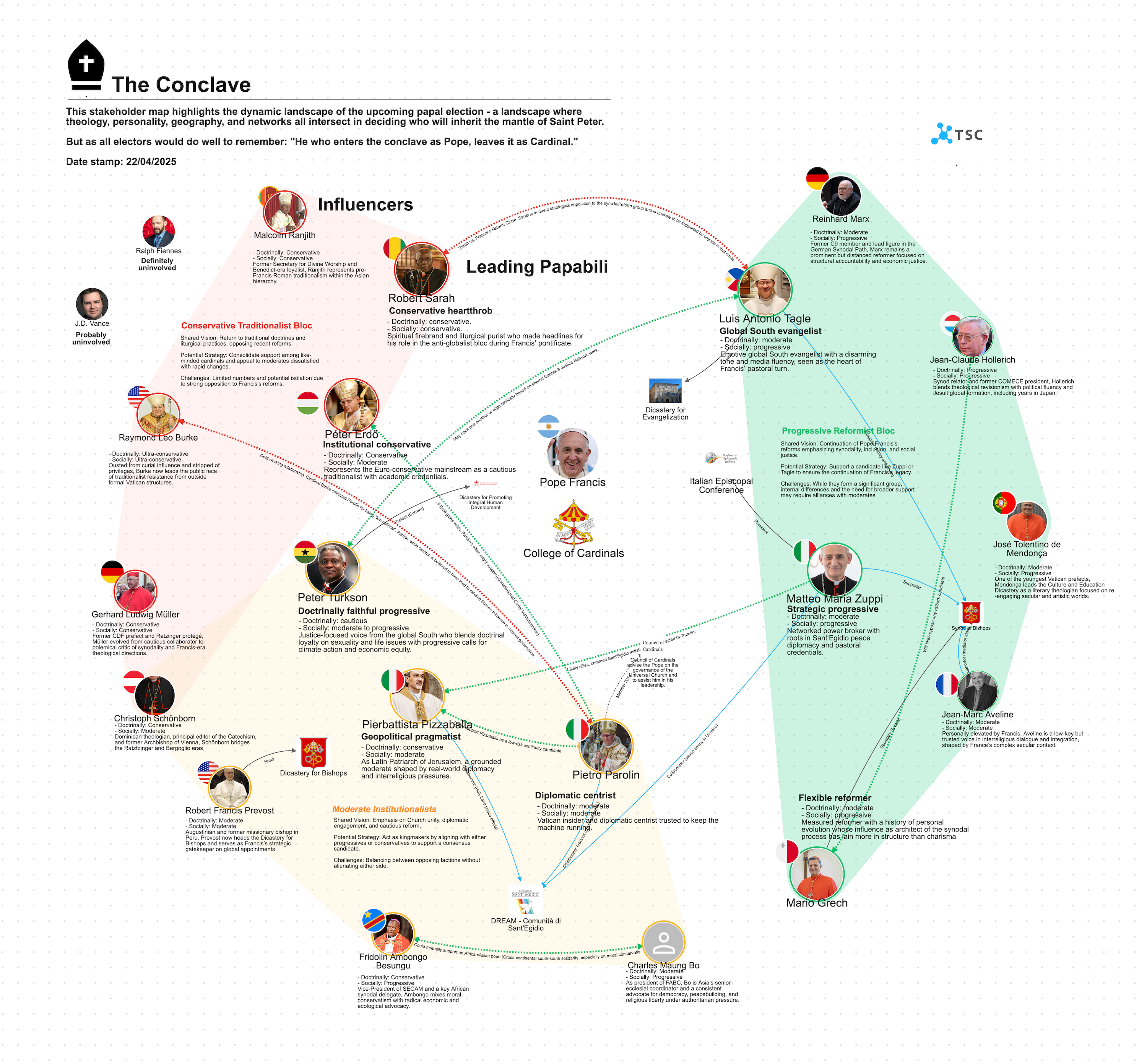
The team leveraged Genie’s dynamic, colour-coded stakeholder network maps for each subsidiary, the federal Legislative branch, and the executive branch - including key ministries responsible for infrastructure, energy, environment, and agriculture.
Each map visualises stakeholder positioning - opposition, support, or neutrality - and is enriched with media intelligence, engagement history, and AI-generated insights that identify strategic gaps and recommend engagement priorities.
For environmental licensing, state-level maps were created overlaying political stakeholders with their positions on licensing reform. The maps became a core tool for subsidiary discussions, guiding where to direct future engagement with public authorities and recording all interactions in the system.
The board mandated that the Risk function deliver structured analysis of external factors such as market dynamics, regulatory shifts, supplier vulnerabilities, and environmental risks that could affect operations. The team lacked a systematic way to track emerging risks, despite recognising the need.
The Risk team adopted Genie as their external sensing layer, with monitoring configured across priority themes: the free energy market and commercialisation, regulatory changes at the national energy regulator, data centre expansion, environmental licensing, energy auctions and competitor activity, regional development, supply chain and key suppliers, and extreme weather events.
A dedicated newsletter was distributed to the entire Risk team, and dashboards provided continuous visibility into issue trends and news volume spikes. The team began structuring projects within Genie based on the company's risk matrix, aligning each monitored topic with the formal risk assessment framework. The AI capability for summarising multiple news articles and analysing stakeholder impact became a valued feature, enabling the team to generate rapid briefings without dedicated analysts for each theme.
"The tool is excellent for understanding the external scenario. We want to migrate the entire process of external factor monitoring into it." - Senior Risk Analyst - on Genie's value for external risk monitoring
What began as a stakeholder management platform for Institutional Relations has expanded into a cross-functional intelligence layer spanning legislative tracking, subsidiary coordination, risk monitoring, and compliance reporting. The company now operates with a shared view of its external environment, from active legislation and political positioning to emerging market risks and environmental threats - creating the structured external sensing capability that a post-privatisation energy company of this scale requires. The platform's adoption across multiple functions and ongoing expansion toward Communications, Compliance, and Regulatory teams positions TSC.ai as the operational backbone for the company's external intelligence.
One of Latin America's largest electricity companies operates across hydroelectric generation and high-voltage transmission, with multiple subsidiaries spanning Brazil's key energy-producing regions. With close to R 50 billion in annual gross revenue and operations concentrated across half a dozen states, the company engages with a complex ecosystem of federal and state regulators, legislators, energy associations, and public authorities.
Following its privatisation, the company faced a step-change in the complexity of its external environment. The Institutional Relations (IR) team needed to monitor over twenty active legislative projects and provisional measures across energy policy, while simultaneously managing stakeholder relationships spanning federal ministries, state legislatures, the national energy regulator, and the company's own subsidiaries.
In parallel, the Risk function was tasked by the board with building a structured capability to analyse external factors from regulatory shifts and supply chain vulnerabilities to extreme weather events that could affect operations. Neither function had a centralised system to support this work.
The company's external-facing teams faced distinct but interconnected structural gaps:
• The IR team had previously relied on a local legislative monitoring platform that offered static stakeholder profiles with no dynamic maps, connections, or cross-referencing of themes, forcing the team to manually print and update maps with no insight into relationships or positioning.
• Approximately 400 stakeholders across federal, state, and subsidiary levels lacked consistent profiling, with engagement records scattered between internal spreadsheets, the compliance platform, and an external political consultancy.
• Legislative monitoring was fragmented: the internal team tracked some projects, the external consultancy provided a weekly risk matrix, and neither feed was connected to stakeholder intelligence or media monitoring, making it difficult to identify strategic engagement opportunities around active legislation.
• The Risk team lacked any structured tool for monitoring emerging external factors from energy market shifts and regulatory changes to data centre expansion, environmental licensing, and extreme climate events.
• Cross-functional visibility was minimal: the IR team, the Risk team, and the subsidiary-facing teams each operated from different cities with separate information sources and no shared institutional memory.
TSC.ai configured Genie to serve two distinct but interconnected functions. For Institutional Relations, the platform became a legislative tracking and stakeholder intelligence hub. Each active legislative project and provisional measure was set up as a monitored project, with mapped stakeholders, linked media coverage, and AI-powered analysis of positioning and strategic gaps.
For the Risk team, the same infrastructure was adapted for emerging risk monitoring, scanning for market shifts, regulatory changes, supply chain vulnerabilities, and environmental events across the country's energy landscape.
A shared newsletter, curated dashboards, and engagement documentation through touchpoint tracking provided the connective tissue between the two functions and fed directly into compliance reporting.
The Institutional Relations team needed to monitor over twenty active legislative projects and provisional measures simultaneously, covering issues from energy storage and offshore wind to clean energy certification, data centres, and dam safety. The team relied on a weekly risk matrix from an external political consultancy, which classified each project by impact and probability of approval, but this information existed outside the company's stakeholder intelligence system. There was no way to see, in one view, which legislators were involved in a given project, what media coverage was developing around it, or where engagement efforts should be directed.
Each legislative project was set up as a monitored project in Genie, with mapped stakeholders, linked news articles, and issue-specific dashboards. The system enabled the team to overlay the consultancy's risk classifications with Genie’s stakeholder and media intelligence - identifying not just which projects were likely to advance, but who the key decision-makers were and what positions they held.
AI-powered analysis provided strategic gap assessments, flagging where the company lacked engagement on high-impact legislation. The team is now restructuring projects around macro-themes - such as energy storage, clean energy certification, and environmental licensing - to create a broader strategic view that connects individual projects, decrees, and regulatory consultations under unified intelligence frameworks.
"The quality and organisation of the report is excellent - it is strategic material for monitoring and analysing our institutional contacts." - Senior member of the Institutional Relations team - on the Touchpoints/Engagement Report
The company's multi-subsidiary structure meant that stakeholder relationships with federal and state authorities were managed independently across four major operating subsidiaries, with no shared view of who was engaging whom. The previous system offered static profiles that required manual updates and could not visualise connections between stakeholders, nor their positioning on issues relevant to the company. When preparing for meetings with subsidiary directors or public authorities, the IR team had to assemble briefing materials from scratch.
The team leveraged Genie’s dynamic, colour-coded stakeholder network maps for each subsidiary, the federal Legislative branch, and the executive branch - including key ministries responsible for infrastructure, energy, environment, and agriculture.
Each map visualises stakeholder positioning - opposition, support, or neutrality - and is enriched with media intelligence, engagement history, and AI-generated insights that identify strategic gaps and recommend engagement priorities.
For environmental licensing, state-level maps were created overlaying political stakeholders with their positions on licensing reform. The maps became a core tool for subsidiary discussions, guiding where to direct future engagement with public authorities and recording all interactions in the system.
The board mandated that the Risk function deliver structured analysis of external factors such as market dynamics, regulatory shifts, supplier vulnerabilities, and environmental risks that could affect operations. The team lacked a systematic way to track emerging risks, despite recognising the need.
The Risk team adopted Genie as their external sensing layer, with monitoring configured across priority themes: the free energy market and commercialisation, regulatory changes at the national energy regulator, data centre expansion, environmental licensing, energy auctions and competitor activity, regional development, supply chain and key suppliers, and extreme weather events.
A dedicated newsletter was distributed to the entire Risk team, and dashboards provided continuous visibility into issue trends and news volume spikes. The team began structuring projects within Genie based on the company's risk matrix, aligning each monitored topic with the formal risk assessment framework. The AI capability for summarising multiple news articles and analysing stakeholder impact became a valued feature, enabling the team to generate rapid briefings without dedicated analysts for each theme.
"The tool is excellent for understanding the external scenario. We want to migrate the entire process of external factor monitoring into it." - Senior Risk Analyst - on Genie's value for external risk monitoring
What began as a stakeholder management platform for Institutional Relations has expanded into a cross-functional intelligence layer spanning legislative tracking, subsidiary coordination, risk monitoring, and compliance reporting. The company now operates with a shared view of its external environment, from active legislation and political positioning to emerging market risks and environmental threats - creating the structured external sensing capability that a post-privatisation energy company of this scale requires. The platform's adoption across multiple functions and ongoing expansion toward Communications, Compliance, and Regulatory teams positions TSC.ai as the operational backbone for the company's external intelligence.
One of Latin America's largest electricity companies operates across hydroelectric generation and high-voltage transmission, with multiple subsidiaries spanning Brazil's key energy-producing regions. With close to R 50 billion in annual gross revenue and operations concentrated across half a dozen states, the company engages with a complex ecosystem of federal and state regulators, legislators, energy associations, and public authorities.
Following its privatisation, the company faced a step-change in the complexity of its external environment. The Institutional Relations (IR) team needed to monitor over twenty active legislative projects and provisional measures across energy policy, while simultaneously managing stakeholder relationships spanning federal ministries, state legislatures, the national energy regulator, and the company's own subsidiaries.
In parallel, the Risk function was tasked by the board with building a structured capability to analyse external factors from regulatory shifts and supply chain vulnerabilities to extreme weather events that could affect operations. Neither function had a centralised system to support this work.
The company's external-facing teams faced distinct but interconnected structural gaps:
• The IR team had previously relied on a local legislative monitoring platform that offered static stakeholder profiles with no dynamic maps, connections, or cross-referencing of themes, forcing the team to manually print and update maps with no insight into relationships or positioning.
• Approximately 400 stakeholders across federal, state, and subsidiary levels lacked consistent profiling, with engagement records scattered between internal spreadsheets, the compliance platform, and an external political consultancy.
• Legislative monitoring was fragmented: the internal team tracked some projects, the external consultancy provided a weekly risk matrix, and neither feed was connected to stakeholder intelligence or media monitoring, making it difficult to identify strategic engagement opportunities around active legislation.
• The Risk team lacked any structured tool for monitoring emerging external factors from energy market shifts and regulatory changes to data centre expansion, environmental licensing, and extreme climate events.
• Cross-functional visibility was minimal: the IR team, the Risk team, and the subsidiary-facing teams each operated from different cities with separate information sources and no shared institutional memory.
TSC.ai configured Genie to serve two distinct but interconnected functions. For Institutional Relations, the platform became a legislative tracking and stakeholder intelligence hub. Each active legislative project and provisional measure was set up as a monitored project, with mapped stakeholders, linked media coverage, and AI-powered analysis of positioning and strategic gaps.
For the Risk team, the same infrastructure was adapted for emerging risk monitoring, scanning for market shifts, regulatory changes, supply chain vulnerabilities, and environmental events across the country's energy landscape.
A shared newsletter, curated dashboards, and engagement documentation through touchpoint tracking provided the connective tissue between the two functions and fed directly into compliance reporting.
The Institutional Relations team needed to monitor over twenty active legislative projects and provisional measures simultaneously, covering issues from energy storage and offshore wind to clean energy certification, data centres, and dam safety. The team relied on a weekly risk matrix from an external political consultancy, which classified each project by impact and probability of approval, but this information existed outside the company's stakeholder intelligence system. There was no way to see, in one view, which legislators were involved in a given project, what media coverage was developing around it, or where engagement efforts should be directed.
Each legislative project was set up as a monitored project in Genie, with mapped stakeholders, linked news articles, and issue-specific dashboards. The system enabled the team to overlay the consultancy's risk classifications with Genie’s stakeholder and media intelligence - identifying not just which projects were likely to advance, but who the key decision-makers were and what positions they held.
AI-powered analysis provided strategic gap assessments, flagging where the company lacked engagement on high-impact legislation. The team is now restructuring projects around macro-themes - such as energy storage, clean energy certification, and environmental licensing - to create a broader strategic view that connects individual projects, decrees, and regulatory consultations under unified intelligence frameworks.
"The quality and organisation of the report is excellent - it is strategic material for monitoring and analysing our institutional contacts." - Senior member of the Institutional Relations team - on the Touchpoints/Engagement Report
The company's multi-subsidiary structure meant that stakeholder relationships with federal and state authorities were managed independently across four major operating subsidiaries, with no shared view of who was engaging whom. The previous system offered static profiles that required manual updates and could not visualise connections between stakeholders, nor their positioning on issues relevant to the company. When preparing for meetings with subsidiary directors or public authorities, the IR team had to assemble briefing materials from scratch.
The team leveraged Genie’s dynamic, colour-coded stakeholder network maps for each subsidiary, the federal Legislative branch, and the executive branch - including key ministries responsible for infrastructure, energy, environment, and agriculture.
Each map visualises stakeholder positioning - opposition, support, or neutrality - and is enriched with media intelligence, engagement history, and AI-generated insights that identify strategic gaps and recommend engagement priorities.
For environmental licensing, state-level maps were created overlaying political stakeholders with their positions on licensing reform. The maps became a core tool for subsidiary discussions, guiding where to direct future engagement with public authorities and recording all interactions in the system.
The board mandated that the Risk function deliver structured analysis of external factors such as market dynamics, regulatory shifts, supplier vulnerabilities, and environmental risks that could affect operations. The team lacked a systematic way to track emerging risks, despite recognising the need.
The Risk team adopted Genie as their external sensing layer, with monitoring configured across priority themes: the free energy market and commercialisation, regulatory changes at the national energy regulator, data centre expansion, environmental licensing, energy auctions and competitor activity, regional development, supply chain and key suppliers, and extreme weather events.
A dedicated newsletter was distributed to the entire Risk team, and dashboards provided continuous visibility into issue trends and news volume spikes. The team began structuring projects within Genie based on the company's risk matrix, aligning each monitored topic with the formal risk assessment framework. The AI capability for summarising multiple news articles and analysing stakeholder impact became a valued feature, enabling the team to generate rapid briefings without dedicated analysts for each theme.
"The tool is excellent for understanding the external scenario. We want to migrate the entire process of external factor monitoring into it." - Senior Risk Analyst - on Genie's value for external risk monitoring
What began as a stakeholder management platform for Institutional Relations has expanded into a cross-functional intelligence layer spanning legislative tracking, subsidiary coordination, risk monitoring, and compliance reporting. The company now operates with a shared view of its external environment, from active legislation and political positioning to emerging market risks and environmental threats - creating the structured external sensing capability that a post-privatisation energy company of this scale requires. The platform's adoption across multiple functions and ongoing expansion toward Communications, Compliance, and Regulatory teams positions TSC.ai as the operational backbone for the company's external intelligence.
One of Latin America's largest electricity companies operates across hydroelectric generation and high-voltage transmission, with multiple subsidiaries spanning Brazil's key energy-producing regions. With close to R 50 billion in annual gross revenue and operations concentrated across half a dozen states, the company engages with a complex ecosystem of federal and state regulators, legislators, energy associations, and public authorities.
Following its privatisation, the company faced a step-change in the complexity of its external environment. The Institutional Relations (IR) team needed to monitor over twenty active legislative projects and provisional measures across energy policy, while simultaneously managing stakeholder relationships spanning federal ministries, state legislatures, the national energy regulator, and the company's own subsidiaries.
In parallel, the Risk function was tasked by the board with building a structured capability to analyse external factors from regulatory shifts and supply chain vulnerabilities to extreme weather events that could affect operations. Neither function had a centralised system to support this work.
The company's external-facing teams faced distinct but interconnected structural gaps:
• The IR team had previously relied on a local legislative monitoring platform that offered static stakeholder profiles with no dynamic maps, connections, or cross-referencing of themes, forcing the team to manually print and update maps with no insight into relationships or positioning.
• Approximately 400 stakeholders across federal, state, and subsidiary levels lacked consistent profiling, with engagement records scattered between internal spreadsheets, the compliance platform, and an external political consultancy.
• Legislative monitoring was fragmented: the internal team tracked some projects, the external consultancy provided a weekly risk matrix, and neither feed was connected to stakeholder intelligence or media monitoring, making it difficult to identify strategic engagement opportunities around active legislation.
• The Risk team lacked any structured tool for monitoring emerging external factors from energy market shifts and regulatory changes to data centre expansion, environmental licensing, and extreme climate events.
• Cross-functional visibility was minimal: the IR team, the Risk team, and the subsidiary-facing teams each operated from different cities with separate information sources and no shared institutional memory.
TSC.ai configured Genie to serve two distinct but interconnected functions. For Institutional Relations, the platform became a legislative tracking and stakeholder intelligence hub. Each active legislative project and provisional measure was set up as a monitored project, with mapped stakeholders, linked media coverage, and AI-powered analysis of positioning and strategic gaps.
For the Risk team, the same infrastructure was adapted for emerging risk monitoring, scanning for market shifts, regulatory changes, supply chain vulnerabilities, and environmental events across the country's energy landscape.
A shared newsletter, curated dashboards, and engagement documentation through touchpoint tracking provided the connective tissue between the two functions and fed directly into compliance reporting.
The Institutional Relations team needed to monitor over twenty active legislative projects and provisional measures simultaneously, covering issues from energy storage and offshore wind to clean energy certification, data centres, and dam safety. The team relied on a weekly risk matrix from an external political consultancy, which classified each project by impact and probability of approval, but this information existed outside the company's stakeholder intelligence system. There was no way to see, in one view, which legislators were involved in a given project, what media coverage was developing around it, or where engagement efforts should be directed.
Each legislative project was set up as a monitored project in Genie, with mapped stakeholders, linked news articles, and issue-specific dashboards. The system enabled the team to overlay the consultancy's risk classifications with Genie’s stakeholder and media intelligence - identifying not just which projects were likely to advance, but who the key decision-makers were and what positions they held.
AI-powered analysis provided strategic gap assessments, flagging where the company lacked engagement on high-impact legislation. The team is now restructuring projects around macro-themes - such as energy storage, clean energy certification, and environmental licensing - to create a broader strategic view that connects individual projects, decrees, and regulatory consultations under unified intelligence frameworks.
"The quality and organisation of the report is excellent - it is strategic material for monitoring and analysing our institutional contacts." - Senior member of the Institutional Relations team - on the Touchpoints/Engagement Report
The company's multi-subsidiary structure meant that stakeholder relationships with federal and state authorities were managed independently across four major operating subsidiaries, with no shared view of who was engaging whom. The previous system offered static profiles that required manual updates and could not visualise connections between stakeholders, nor their positioning on issues relevant to the company. When preparing for meetings with subsidiary directors or public authorities, the IR team had to assemble briefing materials from scratch.
The team leveraged Genie’s dynamic, colour-coded stakeholder network maps for each subsidiary, the federal Legislative branch, and the executive branch - including key ministries responsible for infrastructure, energy, environment, and agriculture.
Each map visualises stakeholder positioning - opposition, support, or neutrality - and is enriched with media intelligence, engagement history, and AI-generated insights that identify strategic gaps and recommend engagement priorities.
For environmental licensing, state-level maps were created overlaying political stakeholders with their positions on licensing reform. The maps became a core tool for subsidiary discussions, guiding where to direct future engagement with public authorities and recording all interactions in the system.
The board mandated that the Risk function deliver structured analysis of external factors such as market dynamics, regulatory shifts, supplier vulnerabilities, and environmental risks that could affect operations. The team lacked a systematic way to track emerging risks, despite recognising the need.
The Risk team adopted Genie as their external sensing layer, with monitoring configured across priority themes: the free energy market and commercialisation, regulatory changes at the national energy regulator, data centre expansion, environmental licensing, energy auctions and competitor activity, regional development, supply chain and key suppliers, and extreme weather events.
A dedicated newsletter was distributed to the entire Risk team, and dashboards provided continuous visibility into issue trends and news volume spikes. The team began structuring projects within Genie based on the company's risk matrix, aligning each monitored topic with the formal risk assessment framework. The AI capability for summarising multiple news articles and analysing stakeholder impact became a valued feature, enabling the team to generate rapid briefings without dedicated analysts for each theme.
"The tool is excellent for understanding the external scenario. We want to migrate the entire process of external factor monitoring into it." - Senior Risk Analyst - on Genie's value for external risk monitoring
What began as a stakeholder management platform for Institutional Relations has expanded into a cross-functional intelligence layer spanning legislative tracking, subsidiary coordination, risk monitoring, and compliance reporting. The company now operates with a shared view of its external environment, from active legislation and political positioning to emerging market risks and environmental threats - creating the structured external sensing capability that a post-privatisation energy company of this scale requires. The platform's adoption across multiple functions and ongoing expansion toward Communications, Compliance, and Regulatory teams positions TSC.ai as the operational backbone for the company's external intelligence.
One of Latin America's largest electricity companies operates across hydroelectric generation and high-voltage transmission, with multiple subsidiaries spanning Brazil's key energy-producing regions. With close to R 50 billion in annual gross revenue and operations concentrated across half a dozen states, the company engages with a complex ecosystem of federal and state regulators, legislators, energy associations, and public authorities.
Following its privatisation, the company faced a step-change in the complexity of its external environment. The Institutional Relations (IR) team needed to monitor over twenty active legislative projects and provisional measures across energy policy, while simultaneously managing stakeholder relationships spanning federal ministries, state legislatures, the national energy regulator, and the company's own subsidiaries.
In parallel, the Risk function was tasked by the board with building a structured capability to analyse external factors from regulatory shifts and supply chain vulnerabilities to extreme weather events that could affect operations. Neither function had a centralised system to support this work.
The company's external-facing teams faced distinct but interconnected structural gaps:
• The IR team had previously relied on a local legislative monitoring platform that offered static stakeholder profiles with no dynamic maps, connections, or cross-referencing of themes, forcing the team to manually print and update maps with no insight into relationships or positioning.
• Approximately 400 stakeholders across federal, state, and subsidiary levels lacked consistent profiling, with engagement records scattered between internal spreadsheets, the compliance platform, and an external political consultancy.
• Legislative monitoring was fragmented: the internal team tracked some projects, the external consultancy provided a weekly risk matrix, and neither feed was connected to stakeholder intelligence or media monitoring, making it difficult to identify strategic engagement opportunities around active legislation.
• The Risk team lacked any structured tool for monitoring emerging external factors from energy market shifts and regulatory changes to data centre expansion, environmental licensing, and extreme climate events.
• Cross-functional visibility was minimal: the IR team, the Risk team, and the subsidiary-facing teams each operated from different cities with separate information sources and no shared institutional memory.
TSC.ai configured Genie to serve two distinct but interconnected functions. For Institutional Relations, the platform became a legislative tracking and stakeholder intelligence hub. Each active legislative project and provisional measure was set up as a monitored project, with mapped stakeholders, linked media coverage, and AI-powered analysis of positioning and strategic gaps.
For the Risk team, the same infrastructure was adapted for emerging risk monitoring, scanning for market shifts, regulatory changes, supply chain vulnerabilities, and environmental events across the country's energy landscape.
A shared newsletter, curated dashboards, and engagement documentation through touchpoint tracking provided the connective tissue between the two functions and fed directly into compliance reporting.
The Institutional Relations team needed to monitor over twenty active legislative projects and provisional measures simultaneously, covering issues from energy storage and offshore wind to clean energy certification, data centres, and dam safety. The team relied on a weekly risk matrix from an external political consultancy, which classified each project by impact and probability of approval, but this information existed outside the company's stakeholder intelligence system. There was no way to see, in one view, which legislators were involved in a given project, what media coverage was developing around it, or where engagement efforts should be directed.
Each legislative project was set up as a monitored project in Genie, with mapped stakeholders, linked news articles, and issue-specific dashboards. The system enabled the team to overlay the consultancy's risk classifications with Genie’s stakeholder and media intelligence - identifying not just which projects were likely to advance, but who the key decision-makers were and what positions they held.
AI-powered analysis provided strategic gap assessments, flagging where the company lacked engagement on high-impact legislation. The team is now restructuring projects around macro-themes - such as energy storage, clean energy certification, and environmental licensing - to create a broader strategic view that connects individual projects, decrees, and regulatory consultations under unified intelligence frameworks.
"The quality and organisation of the report is excellent - it is strategic material for monitoring and analysing our institutional contacts." - Senior member of the Institutional Relations team - on the Touchpoints/Engagement Report
The company's multi-subsidiary structure meant that stakeholder relationships with federal and state authorities were managed independently across four major operating subsidiaries, with no shared view of who was engaging whom. The previous system offered static profiles that required manual updates and could not visualise connections between stakeholders, nor their positioning on issues relevant to the company. When preparing for meetings with subsidiary directors or public authorities, the IR team had to assemble briefing materials from scratch.
The team leveraged Genie’s dynamic, colour-coded stakeholder network maps for each subsidiary, the federal Legislative branch, and the executive branch - including key ministries responsible for infrastructure, energy, environment, and agriculture.
Each map visualises stakeholder positioning - opposition, support, or neutrality - and is enriched with media intelligence, engagement history, and AI-generated insights that identify strategic gaps and recommend engagement priorities.
For environmental licensing, state-level maps were created overlaying political stakeholders with their positions on licensing reform. The maps became a core tool for subsidiary discussions, guiding where to direct future engagement with public authorities and recording all interactions in the system.
The board mandated that the Risk function deliver structured analysis of external factors such as market dynamics, regulatory shifts, supplier vulnerabilities, and environmental risks that could affect operations. The team lacked a systematic way to track emerging risks, despite recognising the need.
The Risk team adopted Genie as their external sensing layer, with monitoring configured across priority themes: the free energy market and commercialisation, regulatory changes at the national energy regulator, data centre expansion, environmental licensing, energy auctions and competitor activity, regional development, supply chain and key suppliers, and extreme weather events.
A dedicated newsletter was distributed to the entire Risk team, and dashboards provided continuous visibility into issue trends and news volume spikes. The team began structuring projects within Genie based on the company's risk matrix, aligning each monitored topic with the formal risk assessment framework. The AI capability for summarising multiple news articles and analysing stakeholder impact became a valued feature, enabling the team to generate rapid briefings without dedicated analysts for each theme.
"The tool is excellent for understanding the external scenario. We want to migrate the entire process of external factor monitoring into it." - Senior Risk Analyst - on Genie's value for external risk monitoring
What began as a stakeholder management platform for Institutional Relations has expanded into a cross-functional intelligence layer spanning legislative tracking, subsidiary coordination, risk monitoring, and compliance reporting. The company now operates with a shared view of its external environment, from active legislation and political positioning to emerging market risks and environmental threats - creating the structured external sensing capability that a post-privatisation energy company of this scale requires. The platform's adoption across multiple functions and ongoing expansion toward Communications, Compliance, and Regulatory teams positions TSC.ai as the operational backbone for the company's external intelligence.
One of Latin America's largest electricity companies operates across hydroelectric generation and high-voltage transmission, with multiple subsidiaries spanning Brazil's key energy-producing regions. With close to R 50 billion in annual gross revenue and operations concentrated across half a dozen states, the company engages with a complex ecosystem of federal and state regulators, legislators, energy associations, and public authorities.
Following its privatisation, the company faced a step-change in the complexity of its external environment. The Institutional Relations (IR) team needed to monitor over twenty active legislative projects and provisional measures across energy policy, while simultaneously managing stakeholder relationships spanning federal ministries, state legislatures, the national energy regulator, and the company's own subsidiaries.
In parallel, the Risk function was tasked by the board with building a structured capability to analyse external factors from regulatory shifts and supply chain vulnerabilities to extreme weather events that could affect operations. Neither function had a centralised system to support this work.
The company's external-facing teams faced distinct but interconnected structural gaps:
• The IR team had previously relied on a local legislative monitoring platform that offered static stakeholder profiles with no dynamic maps, connections, or cross-referencing of themes, forcing the team to manually print and update maps with no insight into relationships or positioning.
• Approximately 400 stakeholders across federal, state, and subsidiary levels lacked consistent profiling, with engagement records scattered between internal spreadsheets, the compliance platform, and an external political consultancy.
• Legislative monitoring was fragmented: the internal team tracked some projects, the external consultancy provided a weekly risk matrix, and neither feed was connected to stakeholder intelligence or media monitoring, making it difficult to identify strategic engagement opportunities around active legislation.
• The Risk team lacked any structured tool for monitoring emerging external factors from energy market shifts and regulatory changes to data centre expansion, environmental licensing, and extreme climate events.
• Cross-functional visibility was minimal: the IR team, the Risk team, and the subsidiary-facing teams each operated from different cities with separate information sources and no shared institutional memory.
TSC.ai configured Genie to serve two distinct but interconnected functions. For Institutional Relations, the platform became a legislative tracking and stakeholder intelligence hub. Each active legislative project and provisional measure was set up as a monitored project, with mapped stakeholders, linked media coverage, and AI-powered analysis of positioning and strategic gaps.
For the Risk team, the same infrastructure was adapted for emerging risk monitoring, scanning for market shifts, regulatory changes, supply chain vulnerabilities, and environmental events across the country's energy landscape.
A shared newsletter, curated dashboards, and engagement documentation through touchpoint tracking provided the connective tissue between the two functions and fed directly into compliance reporting.
The Institutional Relations team needed to monitor over twenty active legislative projects and provisional measures simultaneously, covering issues from energy storage and offshore wind to clean energy certification, data centres, and dam safety. The team relied on a weekly risk matrix from an external political consultancy, which classified each project by impact and probability of approval, but this information existed outside the company's stakeholder intelligence system. There was no way to see, in one view, which legislators were involved in a given project, what media coverage was developing around it, or where engagement efforts should be directed.
Each legislative project was set up as a monitored project in Genie, with mapped stakeholders, linked news articles, and issue-specific dashboards. The system enabled the team to overlay the consultancy's risk classifications with Genie’s stakeholder and media intelligence - identifying not just which projects were likely to advance, but who the key decision-makers were and what positions they held.
AI-powered analysis provided strategic gap assessments, flagging where the company lacked engagement on high-impact legislation. The team is now restructuring projects around macro-themes - such as energy storage, clean energy certification, and environmental licensing - to create a broader strategic view that connects individual projects, decrees, and regulatory consultations under unified intelligence frameworks.
"The quality and organisation of the report is excellent - it is strategic material for monitoring and analysing our institutional contacts." - Senior member of the Institutional Relations team - on the Touchpoints/Engagement Report
The company's multi-subsidiary structure meant that stakeholder relationships with federal and state authorities were managed independently across four major operating subsidiaries, with no shared view of who was engaging whom. The previous system offered static profiles that required manual updates and could not visualise connections between stakeholders, nor their positioning on issues relevant to the company. When preparing for meetings with subsidiary directors or public authorities, the IR team had to assemble briefing materials from scratch.
The team leveraged Genie’s dynamic, colour-coded stakeholder network maps for each subsidiary, the federal Legislative branch, and the executive branch - including key ministries responsible for infrastructure, energy, environment, and agriculture.
Each map visualises stakeholder positioning - opposition, support, or neutrality - and is enriched with media intelligence, engagement history, and AI-generated insights that identify strategic gaps and recommend engagement priorities.
For environmental licensing, state-level maps were created overlaying political stakeholders with their positions on licensing reform. The maps became a core tool for subsidiary discussions, guiding where to direct future engagement with public authorities and recording all interactions in the system.
The board mandated that the Risk function deliver structured analysis of external factors such as market dynamics, regulatory shifts, supplier vulnerabilities, and environmental risks that could affect operations. The team lacked a systematic way to track emerging risks, despite recognising the need.
The Risk team adopted Genie as their external sensing layer, with monitoring configured across priority themes: the free energy market and commercialisation, regulatory changes at the national energy regulator, data centre expansion, environmental licensing, energy auctions and competitor activity, regional development, supply chain and key suppliers, and extreme weather events.
A dedicated newsletter was distributed to the entire Risk team, and dashboards provided continuous visibility into issue trends and news volume spikes. The team began structuring projects within Genie based on the company's risk matrix, aligning each monitored topic with the formal risk assessment framework. The AI capability for summarising multiple news articles and analysing stakeholder impact became a valued feature, enabling the team to generate rapid briefings without dedicated analysts for each theme.
"The tool is excellent for understanding the external scenario. We want to migrate the entire process of external factor monitoring into it." - Senior Risk Analyst - on Genie's value for external risk monitoring
What began as a stakeholder management platform for Institutional Relations has expanded into a cross-functional intelligence layer spanning legislative tracking, subsidiary coordination, risk monitoring, and compliance reporting. The company now operates with a shared view of its external environment, from active legislation and political positioning to emerging market risks and environmental threats - creating the structured external sensing capability that a post-privatisation energy company of this scale requires. The platform's adoption across multiple functions and ongoing expansion toward Communications, Compliance, and Regulatory teams positions TSC.ai as the operational backbone for the company's external intelligence.
One of Latin America's largest electricity companies operates across hydroelectric generation and high-voltage transmission, with multiple subsidiaries spanning Brazil's key energy-producing regions. With close to R 50 billion in annual gross revenue and operations concentrated across half a dozen states, the company engages with a complex ecosystem of federal and state regulators, legislators, energy associations, and public authorities.
Following its privatisation, the company faced a step-change in the complexity of its external environment. The Institutional Relations (IR) team needed to monitor over twenty active legislative projects and provisional measures across energy policy, while simultaneously managing stakeholder relationships spanning federal ministries, state legislatures, the national energy regulator, and the company's own subsidiaries.
In parallel, the Risk function was tasked by the board with building a structured capability to analyse external factors from regulatory shifts and supply chain vulnerabilities to extreme weather events that could affect operations. Neither function had a centralised system to support this work.
The company's external-facing teams faced distinct but interconnected structural gaps:
• The IR team had previously relied on a local legislative monitoring platform that offered static stakeholder profiles with no dynamic maps, connections, or cross-referencing of themes, forcing the team to manually print and update maps with no insight into relationships or positioning.
• Approximately 400 stakeholders across federal, state, and subsidiary levels lacked consistent profiling, with engagement records scattered between internal spreadsheets, the compliance platform, and an external political consultancy.
• Legislative monitoring was fragmented: the internal team tracked some projects, the external consultancy provided a weekly risk matrix, and neither feed was connected to stakeholder intelligence or media monitoring, making it difficult to identify strategic engagement opportunities around active legislation.
• The Risk team lacked any structured tool for monitoring emerging external factors from energy market shifts and regulatory changes to data centre expansion, environmental licensing, and extreme climate events.
• Cross-functional visibility was minimal: the IR team, the Risk team, and the subsidiary-facing teams each operated from different cities with separate information sources and no shared institutional memory.
TSC.ai configured Genie to serve two distinct but interconnected functions. For Institutional Relations, the platform became a legislative tracking and stakeholder intelligence hub. Each active legislative project and provisional measure was set up as a monitored project, with mapped stakeholders, linked media coverage, and AI-powered analysis of positioning and strategic gaps.
For the Risk team, the same infrastructure was adapted for emerging risk monitoring, scanning for market shifts, regulatory changes, supply chain vulnerabilities, and environmental events across the country's energy landscape.
A shared newsletter, curated dashboards, and engagement documentation through touchpoint tracking provided the connective tissue between the two functions and fed directly into compliance reporting.
The Institutional Relations team needed to monitor over twenty active legislative projects and provisional measures simultaneously, covering issues from energy storage and offshore wind to clean energy certification, data centres, and dam safety. The team relied on a weekly risk matrix from an external political consultancy, which classified each project by impact and probability of approval, but this information existed outside the company's stakeholder intelligence system. There was no way to see, in one view, which legislators were involved in a given project, what media coverage was developing around it, or where engagement efforts should be directed.
Each legislative project was set up as a monitored project in Genie, with mapped stakeholders, linked news articles, and issue-specific dashboards. The system enabled the team to overlay the consultancy's risk classifications with Genie’s stakeholder and media intelligence - identifying not just which projects were likely to advance, but who the key decision-makers were and what positions they held.
AI-powered analysis provided strategic gap assessments, flagging where the company lacked engagement on high-impact legislation. The team is now restructuring projects around macro-themes - such as energy storage, clean energy certification, and environmental licensing - to create a broader strategic view that connects individual projects, decrees, and regulatory consultations under unified intelligence frameworks.
"The quality and organisation of the report is excellent - it is strategic material for monitoring and analysing our institutional contacts." - Senior member of the Institutional Relations team - on the Touchpoints/Engagement Report
The company's multi-subsidiary structure meant that stakeholder relationships with federal and state authorities were managed independently across four major operating subsidiaries, with no shared view of who was engaging whom. The previous system offered static profiles that required manual updates and could not visualise connections between stakeholders, nor their positioning on issues relevant to the company. When preparing for meetings with subsidiary directors or public authorities, the IR team had to assemble briefing materials from scratch.
The team leveraged Genie’s dynamic, colour-coded stakeholder network maps for each subsidiary, the federal Legislative branch, and the executive branch - including key ministries responsible for infrastructure, energy, environment, and agriculture.
Each map visualises stakeholder positioning - opposition, support, or neutrality - and is enriched with media intelligence, engagement history, and AI-generated insights that identify strategic gaps and recommend engagement priorities.
For environmental licensing, state-level maps were created overlaying political stakeholders with their positions on licensing reform. The maps became a core tool for subsidiary discussions, guiding where to direct future engagement with public authorities and recording all interactions in the system.
The board mandated that the Risk function deliver structured analysis of external factors such as market dynamics, regulatory shifts, supplier vulnerabilities, and environmental risks that could affect operations. The team lacked a systematic way to track emerging risks, despite recognising the need.
The Risk team adopted Genie as their external sensing layer, with monitoring configured across priority themes: the free energy market and commercialisation, regulatory changes at the national energy regulator, data centre expansion, environmental licensing, energy auctions and competitor activity, regional development, supply chain and key suppliers, and extreme weather events.
A dedicated newsletter was distributed to the entire Risk team, and dashboards provided continuous visibility into issue trends and news volume spikes. The team began structuring projects within Genie based on the company's risk matrix, aligning each monitored topic with the formal risk assessment framework. The AI capability for summarising multiple news articles and analysing stakeholder impact became a valued feature, enabling the team to generate rapid briefings without dedicated analysts for each theme.
"The tool is excellent for understanding the external scenario. We want to migrate the entire process of external factor monitoring into it." - Senior Risk Analyst - on Genie's value for external risk monitoring
What began as a stakeholder management platform for Institutional Relations has expanded into a cross-functional intelligence layer spanning legislative tracking, subsidiary coordination, risk monitoring, and compliance reporting. The company now operates with a shared view of its external environment, from active legislation and political positioning to emerging market risks and environmental threats - creating the structured external sensing capability that a post-privatisation energy company of this scale requires. The platform's adoption across multiple functions and ongoing expansion toward Communications, Compliance, and Regulatory teams positions TSC.ai as the operational backbone for the company's external intelligence.
One of Latin America's largest electricity companies operates across hydroelectric generation and high-voltage transmission, with multiple subsidiaries spanning Brazil's key energy-producing regions. With close to R 50 billion in annual gross revenue and operations concentrated across half a dozen states, the company engages with a complex ecosystem of federal and state regulators, legislators, energy associations, and public authorities.
Following its privatisation, the company faced a step-change in the complexity of its external environment. The Institutional Relations (IR) team needed to monitor over twenty active legislative projects and provisional measures across energy policy, while simultaneously managing stakeholder relationships spanning federal ministries, state legislatures, the national energy regulator, and the company's own subsidiaries.
In parallel, the Risk function was tasked by the board with building a structured capability to analyse external factors from regulatory shifts and supply chain vulnerabilities to extreme weather events that could affect operations. Neither function had a centralised system to support this work.
The company's external-facing teams faced distinct but interconnected structural gaps:
• The IR team had previously relied on a local legislative monitoring platform that offered static stakeholder profiles with no dynamic maps, connections, or cross-referencing of themes, forcing the team to manually print and update maps with no insight into relationships or positioning.
• Approximately 400 stakeholders across federal, state, and subsidiary levels lacked consistent profiling, with engagement records scattered between internal spreadsheets, the compliance platform, and an external political consultancy.
• Legislative monitoring was fragmented: the internal team tracked some projects, the external consultancy provided a weekly risk matrix, and neither feed was connected to stakeholder intelligence or media monitoring, making it difficult to identify strategic engagement opportunities around active legislation.
• The Risk team lacked any structured tool for monitoring emerging external factors from energy market shifts and regulatory changes to data centre expansion, environmental licensing, and extreme climate events.
• Cross-functional visibility was minimal: the IR team, the Risk team, and the subsidiary-facing teams each operated from different cities with separate information sources and no shared institutional memory.
TSC.ai configured Genie to serve two distinct but interconnected functions. For Institutional Relations, the platform became a legislative tracking and stakeholder intelligence hub. Each active legislative project and provisional measure was set up as a monitored project, with mapped stakeholders, linked media coverage, and AI-powered analysis of positioning and strategic gaps.
For the Risk team, the same infrastructure was adapted for emerging risk monitoring, scanning for market shifts, regulatory changes, supply chain vulnerabilities, and environmental events across the country's energy landscape.
A shared newsletter, curated dashboards, and engagement documentation through touchpoint tracking provided the connective tissue between the two functions and fed directly into compliance reporting.
The Institutional Relations team needed to monitor over twenty active legislative projects and provisional measures simultaneously, covering issues from energy storage and offshore wind to clean energy certification, data centres, and dam safety. The team relied on a weekly risk matrix from an external political consultancy, which classified each project by impact and probability of approval, but this information existed outside the company's stakeholder intelligence system. There was no way to see, in one view, which legislators were involved in a given project, what media coverage was developing around it, or where engagement efforts should be directed.
Each legislative project was set up as a monitored project in Genie, with mapped stakeholders, linked news articles, and issue-specific dashboards. The system enabled the team to overlay the consultancy's risk classifications with Genie’s stakeholder and media intelligence - identifying not just which projects were likely to advance, but who the key decision-makers were and what positions they held.
AI-powered analysis provided strategic gap assessments, flagging where the company lacked engagement on high-impact legislation. The team is now restructuring projects around macro-themes - such as energy storage, clean energy certification, and environmental licensing - to create a broader strategic view that connects individual projects, decrees, and regulatory consultations under unified intelligence frameworks.
"The quality and organisation of the report is excellent - it is strategic material for monitoring and analysing our institutional contacts." - Senior member of the Institutional Relations team - on the Touchpoints/Engagement Report
The company's multi-subsidiary structure meant that stakeholder relationships with federal and state authorities were managed independently across four major operating subsidiaries, with no shared view of who was engaging whom. The previous system offered static profiles that required manual updates and could not visualise connections between stakeholders, nor their positioning on issues relevant to the company. When preparing for meetings with subsidiary directors or public authorities, the IR team had to assemble briefing materials from scratch.
The team leveraged Genie’s dynamic, colour-coded stakeholder network maps for each subsidiary, the federal Legislative branch, and the executive branch - including key ministries responsible for infrastructure, energy, environment, and agriculture.
Each map visualises stakeholder positioning - opposition, support, or neutrality - and is enriched with media intelligence, engagement history, and AI-generated insights that identify strategic gaps and recommend engagement priorities.
For environmental licensing, state-level maps were created overlaying political stakeholders with their positions on licensing reform. The maps became a core tool for subsidiary discussions, guiding where to direct future engagement with public authorities and recording all interactions in the system.
The board mandated that the Risk function deliver structured analysis of external factors such as market dynamics, regulatory shifts, supplier vulnerabilities, and environmental risks that could affect operations. The team lacked a systematic way to track emerging risks, despite recognising the need.
The Risk team adopted Genie as their external sensing layer, with monitoring configured across priority themes: the free energy market and commercialisation, regulatory changes at the national energy regulator, data centre expansion, environmental licensing, energy auctions and competitor activity, regional development, supply chain and key suppliers, and extreme weather events.
A dedicated newsletter was distributed to the entire Risk team, and dashboards provided continuous visibility into issue trends and news volume spikes. The team began structuring projects within Genie based on the company's risk matrix, aligning each monitored topic with the formal risk assessment framework. The AI capability for summarising multiple news articles and analysing stakeholder impact became a valued feature, enabling the team to generate rapid briefings without dedicated analysts for each theme.
"The tool is excellent for understanding the external scenario. We want to migrate the entire process of external factor monitoring into it." - Senior Risk Analyst - on Genie's value for external risk monitoring
What began as a stakeholder management platform for Institutional Relations has expanded into a cross-functional intelligence layer spanning legislative tracking, subsidiary coordination, risk monitoring, and compliance reporting. The company now operates with a shared view of its external environment, from active legislation and political positioning to emerging market risks and environmental threats - creating the structured external sensing capability that a post-privatisation energy company of this scale requires. The platform's adoption across multiple functions and ongoing expansion toward Communications, Compliance, and Regulatory teams positions TSC.ai as the operational backbone for the company's external intelligence.
One of Latin America's largest electricity companies operates across hydroelectric generation and high-voltage transmission, with multiple subsidiaries spanning Brazil's key energy-producing regions. With close to R 50 billion in annual gross revenue and operations concentrated across half a dozen states, the company engages with a complex ecosystem of federal and state regulators, legislators, energy associations, and public authorities.
Following its privatisation, the company faced a step-change in the complexity of its external environment. The Institutional Relations (IR) team needed to monitor over twenty active legislative projects and provisional measures across energy policy, while simultaneously managing stakeholder relationships spanning federal ministries, state legislatures, the national energy regulator, and the company's own subsidiaries.
In parallel, the Risk function was tasked by the board with building a structured capability to analyse external factors from regulatory shifts and supply chain vulnerabilities to extreme weather events that could affect operations. Neither function had a centralised system to support this work.
The company's external-facing teams faced distinct but interconnected structural gaps:
• The IR team had previously relied on a local legislative monitoring platform that offered static stakeholder profiles with no dynamic maps, connections, or cross-referencing of themes, forcing the team to manually print and update maps with no insight into relationships or positioning.
• Approximately 400 stakeholders across federal, state, and subsidiary levels lacked consistent profiling, with engagement records scattered between internal spreadsheets, the compliance platform, and an external political consultancy.
• Legislative monitoring was fragmented: the internal team tracked some projects, the external consultancy provided a weekly risk matrix, and neither feed was connected to stakeholder intelligence or media monitoring, making it difficult to identify strategic engagement opportunities around active legislation.
• The Risk team lacked any structured tool for monitoring emerging external factors from energy market shifts and regulatory changes to data centre expansion, environmental licensing, and extreme climate events.
• Cross-functional visibility was minimal: the IR team, the Risk team, and the subsidiary-facing teams each operated from different cities with separate information sources and no shared institutional memory.
TSC.ai configured Genie to serve two distinct but interconnected functions. For Institutional Relations, the platform became a legislative tracking and stakeholder intelligence hub. Each active legislative project and provisional measure was set up as a monitored project, with mapped stakeholders, linked media coverage, and AI-powered analysis of positioning and strategic gaps.
For the Risk team, the same infrastructure was adapted for emerging risk monitoring, scanning for market shifts, regulatory changes, supply chain vulnerabilities, and environmental events across the country's energy landscape.
A shared newsletter, curated dashboards, and engagement documentation through touchpoint tracking provided the connective tissue between the two functions and fed directly into compliance reporting.
The Institutional Relations team needed to monitor over twenty active legislative projects and provisional measures simultaneously, covering issues from energy storage and offshore wind to clean energy certification, data centres, and dam safety. The team relied on a weekly risk matrix from an external political consultancy, which classified each project by impact and probability of approval, but this information existed outside the company's stakeholder intelligence system. There was no way to see, in one view, which legislators were involved in a given project, what media coverage was developing around it, or where engagement efforts should be directed.
Each legislative project was set up as a monitored project in Genie, with mapped stakeholders, linked news articles, and issue-specific dashboards. The system enabled the team to overlay the consultancy's risk classifications with Genie’s stakeholder and media intelligence - identifying not just which projects were likely to advance, but who the key decision-makers were and what positions they held.
AI-powered analysis provided strategic gap assessments, flagging where the company lacked engagement on high-impact legislation. The team is now restructuring projects around macro-themes - such as energy storage, clean energy certification, and environmental licensing - to create a broader strategic view that connects individual projects, decrees, and regulatory consultations under unified intelligence frameworks.
"The quality and organisation of the report is excellent - it is strategic material for monitoring and analysing our institutional contacts." - Senior member of the Institutional Relations team - on the Touchpoints/Engagement Report
The company's multi-subsidiary structure meant that stakeholder relationships with federal and state authorities were managed independently across four major operating subsidiaries, with no shared view of who was engaging whom. The previous system offered static profiles that required manual updates and could not visualise connections between stakeholders, nor their positioning on issues relevant to the company. When preparing for meetings with subsidiary directors or public authorities, the IR team had to assemble briefing materials from scratch.
The team leveraged Genie’s dynamic, colour-coded stakeholder network maps for each subsidiary, the federal Legislative branch, and the executive branch - including key ministries responsible for infrastructure, energy, environment, and agriculture.
Each map visualises stakeholder positioning - opposition, support, or neutrality - and is enriched with media intelligence, engagement history, and AI-generated insights that identify strategic gaps and recommend engagement priorities.
For environmental licensing, state-level maps were created overlaying political stakeholders with their positions on licensing reform. The maps became a core tool for subsidiary discussions, guiding where to direct future engagement with public authorities and recording all interactions in the system.
The board mandated that the Risk function deliver structured analysis of external factors such as market dynamics, regulatory shifts, supplier vulnerabilities, and environmental risks that could affect operations. The team lacked a systematic way to track emerging risks, despite recognising the need.
The Risk team adopted Genie as their external sensing layer, with monitoring configured across priority themes: the free energy market and commercialisation, regulatory changes at the national energy regulator, data centre expansion, environmental licensing, energy auctions and competitor activity, regional development, supply chain and key suppliers, and extreme weather events.
A dedicated newsletter was distributed to the entire Risk team, and dashboards provided continuous visibility into issue trends and news volume spikes. The team began structuring projects within Genie based on the company's risk matrix, aligning each monitored topic with the formal risk assessment framework. The AI capability for summarising multiple news articles and analysing stakeholder impact became a valued feature, enabling the team to generate rapid briefings without dedicated analysts for each theme.
"The tool is excellent for understanding the external scenario. We want to migrate the entire process of external factor monitoring into it." - Senior Risk Analyst - on Genie's value for external risk monitoring
What began as a stakeholder management platform for Institutional Relations has expanded into a cross-functional intelligence layer spanning legislative tracking, subsidiary coordination, risk monitoring, and compliance reporting. The company now operates with a shared view of its external environment, from active legislation and political positioning to emerging market risks and environmental threats - creating the structured external sensing capability that a post-privatisation energy company of this scale requires. The platform's adoption across multiple functions and ongoing expansion toward Communications, Compliance, and Regulatory teams positions TSC.ai as the operational backbone for the company's external intelligence.

.png)
.png)
.png)




%20(1).png)