Repost from April 2025
Every papal election is framed as a moment of divine discernment.
But behind the closed doors of the Sistine Chapel, it is also a high-stakes exercise in power, influence, and coalition-building.
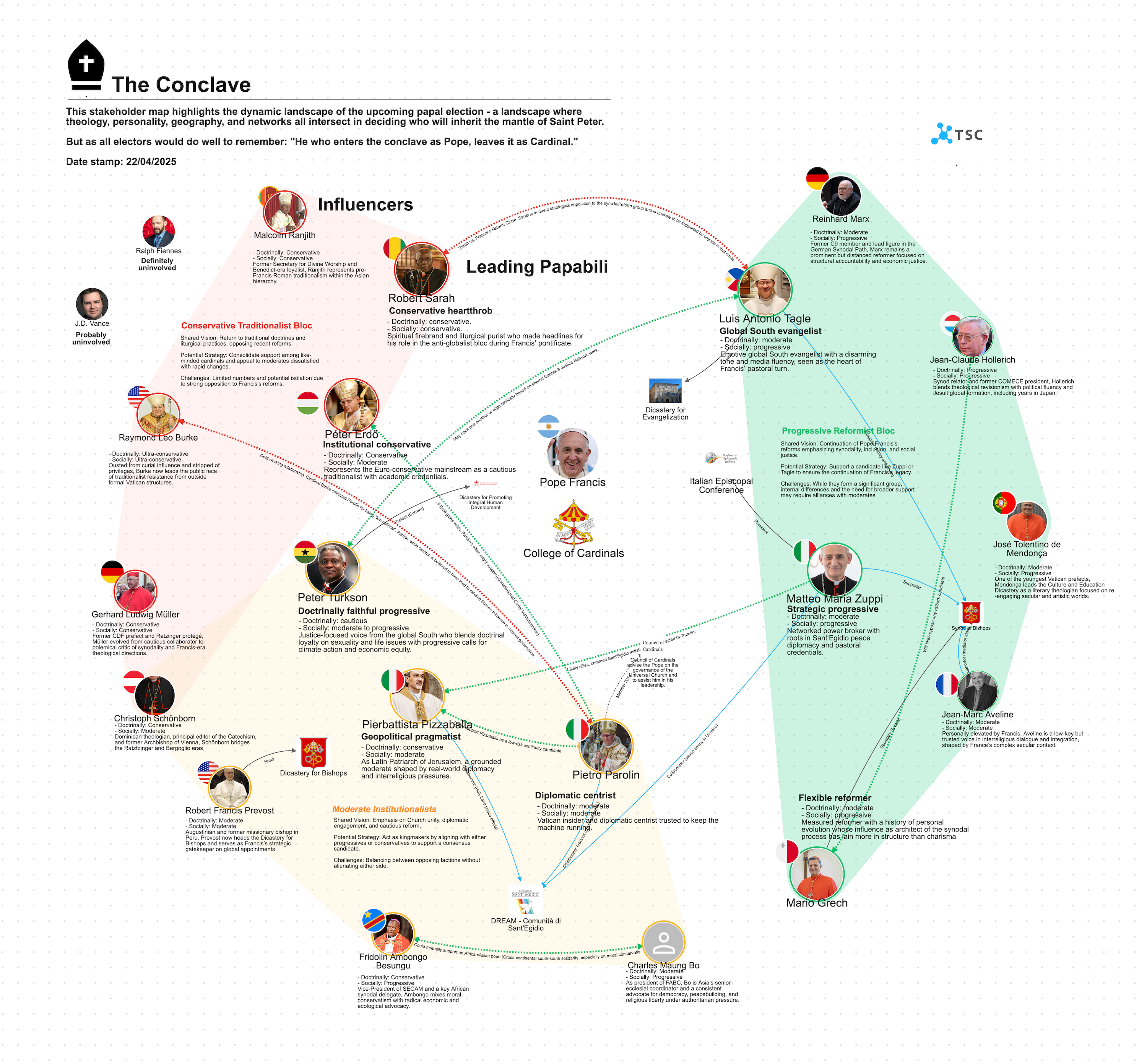
Our #PapalGameofThrones stakeholder map breaks down the inner networks of the upcoming Conclave - mapping not just who the key players are, but how theology, geography, institutional power, and personal alliances intersect to shape the outcome.
130 Cardinals. One decision. Absolute authority.
Just over a hundred men will decide who holds moral, political, and spiritual influence over 1.3 billion Catholics worldwide. Few institutions concentrate power this starkly or this quietly.
Tradition vs. progress, once again.
As in the last conclave, the fault line runs between doctrinal conservatives and reform-minded progressives. But this time, the centre ground matters more than ever. The winner will likely be the figure who can bridge blocs, not dominate one.
This is no longer a European contest.
More than 70% of voting cardinals were appointed by Pope Francis, and fewer than half of the electors are European. The gravitational centre of the Church has shifted, raising real questions about whether the next Pope could be Asian (for the first time) or African (for the first time since 496 AD).
What the map makes clear is this:
the next Pope will not emerge purely from ideology, geography, or seniority. He will emerge from networks - from who is trusted, who is tolerated, and who can survive the final rounds of compromise.
Our bet is on a moderate.
P.S. We’re reasonably confident Ralph Fiennes is not involved, and JD Vance was “probably” not involved.
Repost from April 2025
Every papal election is framed as a moment of divine discernment.
But behind the closed doors of the Sistine Chapel, it is also a high-stakes exercise in power, influence, and coalition-building.
Our #PapalGameofThrones stakeholder map breaks down the inner networks of the upcoming Conclave - mapping not just who the key players are, but how theology, geography, institutional power, and personal alliances intersect to shape the outcome.
130 Cardinals. One decision. Absolute authority.
Just over a hundred men will decide who holds moral, political, and spiritual influence over 1.3 billion Catholics worldwide. Few institutions concentrate power this starkly or this quietly.
Tradition vs. progress, once again.
As in the last conclave, the fault line runs between doctrinal conservatives and reform-minded progressives. But this time, the centre ground matters more than ever. The winner will likely be the figure who can bridge blocs, not dominate one.
This is no longer a European contest.
More than 70% of voting cardinals were appointed by Pope Francis, and fewer than half of the electors are European. The gravitational centre of the Church has shifted, raising real questions about whether the next Pope could be Asian (for the first time) or African (for the first time since 496 AD).
What the map makes clear is this:
the next Pope will not emerge purely from ideology, geography, or seniority. He will emerge from networks - from who is trusted, who is tolerated, and who can survive the final rounds of compromise.
Our bet is on a moderate.
P.S. We’re reasonably confident Ralph Fiennes is not involved, and JD Vance was “probably” not involved.
Repost from April 2025
Every papal election is framed as a moment of divine discernment.
But behind the closed doors of the Sistine Chapel, it is also a high-stakes exercise in power, influence, and coalition-building.
Our #PapalGameofThrones stakeholder map breaks down the inner networks of the upcoming Conclave - mapping not just who the key players are, but how theology, geography, institutional power, and personal alliances intersect to shape the outcome.
130 Cardinals. One decision. Absolute authority.
Just over a hundred men will decide who holds moral, political, and spiritual influence over 1.3 billion Catholics worldwide. Few institutions concentrate power this starkly or this quietly.
Tradition vs. progress, once again.
As in the last conclave, the fault line runs between doctrinal conservatives and reform-minded progressives. But this time, the centre ground matters more than ever. The winner will likely be the figure who can bridge blocs, not dominate one.
This is no longer a European contest.
More than 70% of voting cardinals were appointed by Pope Francis, and fewer than half of the electors are European. The gravitational centre of the Church has shifted, raising real questions about whether the next Pope could be Asian (for the first time) or African (for the first time since 496 AD).
What the map makes clear is this:
the next Pope will not emerge purely from ideology, geography, or seniority. He will emerge from networks - from who is trusted, who is tolerated, and who can survive the final rounds of compromise.
Our bet is on a moderate.
P.S. We’re reasonably confident Ralph Fiennes is not involved, and JD Vance was “probably” not involved.
Repost from April 2025
Every papal election is framed as a moment of divine discernment.
But behind the closed doors of the Sistine Chapel, it is also a high-stakes exercise in power, influence, and coalition-building.
Our #PapalGameofThrones stakeholder map breaks down the inner networks of the upcoming Conclave - mapping not just who the key players are, but how theology, geography, institutional power, and personal alliances intersect to shape the outcome.
130 Cardinals. One decision. Absolute authority.
Just over a hundred men will decide who holds moral, political, and spiritual influence over 1.3 billion Catholics worldwide. Few institutions concentrate power this starkly or this quietly.
Tradition vs. progress, once again.
As in the last conclave, the fault line runs between doctrinal conservatives and reform-minded progressives. But this time, the centre ground matters more than ever. The winner will likely be the figure who can bridge blocs, not dominate one.
This is no longer a European contest.
More than 70% of voting cardinals were appointed by Pope Francis, and fewer than half of the electors are European. The gravitational centre of the Church has shifted, raising real questions about whether the next Pope could be Asian (for the first time) or African (for the first time since 496 AD).
What the map makes clear is this:
the next Pope will not emerge purely from ideology, geography, or seniority. He will emerge from networks - from who is trusted, who is tolerated, and who can survive the final rounds of compromise.
Our bet is on a moderate.
P.S. We’re reasonably confident Ralph Fiennes is not involved, and JD Vance was “probably” not involved.
Repost from April 2025
Every papal election is framed as a moment of divine discernment.
But behind the closed doors of the Sistine Chapel, it is also a high-stakes exercise in power, influence, and coalition-building.
Our #PapalGameofThrones stakeholder map breaks down the inner networks of the upcoming Conclave - mapping not just who the key players are, but how theology, geography, institutional power, and personal alliances intersect to shape the outcome.
130 Cardinals. One decision. Absolute authority.
Just over a hundred men will decide who holds moral, political, and spiritual influence over 1.3 billion Catholics worldwide. Few institutions concentrate power this starkly or this quietly.
Tradition vs. progress, once again.
As in the last conclave, the fault line runs between doctrinal conservatives and reform-minded progressives. But this time, the centre ground matters more than ever. The winner will likely be the figure who can bridge blocs, not dominate one.
This is no longer a European contest.
More than 70% of voting cardinals were appointed by Pope Francis, and fewer than half of the electors are European. The gravitational centre of the Church has shifted, raising real questions about whether the next Pope could be Asian (for the first time) or African (for the first time since 496 AD).
What the map makes clear is this:
the next Pope will not emerge purely from ideology, geography, or seniority. He will emerge from networks - from who is trusted, who is tolerated, and who can survive the final rounds of compromise.
Our bet is on a moderate.
P.S. We’re reasonably confident Ralph Fiennes is not involved, and JD Vance was “probably” not involved.
Repost from April 2025
Every papal election is framed as a moment of divine discernment.
But behind the closed doors of the Sistine Chapel, it is also a high-stakes exercise in power, influence, and coalition-building.
Our #PapalGameofThrones stakeholder map breaks down the inner networks of the upcoming Conclave - mapping not just who the key players are, but how theology, geography, institutional power, and personal alliances intersect to shape the outcome.
130 Cardinals. One decision. Absolute authority.
Just over a hundred men will decide who holds moral, political, and spiritual influence over 1.3 billion Catholics worldwide. Few institutions concentrate power this starkly or this quietly.
Tradition vs. progress, once again.
As in the last conclave, the fault line runs between doctrinal conservatives and reform-minded progressives. But this time, the centre ground matters more than ever. The winner will likely be the figure who can bridge blocs, not dominate one.
This is no longer a European contest.
More than 70% of voting cardinals were appointed by Pope Francis, and fewer than half of the electors are European. The gravitational centre of the Church has shifted, raising real questions about whether the next Pope could be Asian (for the first time) or African (for the first time since 496 AD).
What the map makes clear is this:
the next Pope will not emerge purely from ideology, geography, or seniority. He will emerge from networks - from who is trusted, who is tolerated, and who can survive the final rounds of compromise.
Our bet is on a moderate.
P.S. We’re reasonably confident Ralph Fiennes is not involved, and JD Vance was “probably” not involved.
Repost from April 2025
Every papal election is framed as a moment of divine discernment.
But behind the closed doors of the Sistine Chapel, it is also a high-stakes exercise in power, influence, and coalition-building.
Our #PapalGameofThrones stakeholder map breaks down the inner networks of the upcoming Conclave - mapping not just who the key players are, but how theology, geography, institutional power, and personal alliances intersect to shape the outcome.
130 Cardinals. One decision. Absolute authority.
Just over a hundred men will decide who holds moral, political, and spiritual influence over 1.3 billion Catholics worldwide. Few institutions concentrate power this starkly or this quietly.
Tradition vs. progress, once again.
As in the last conclave, the fault line runs between doctrinal conservatives and reform-minded progressives. But this time, the centre ground matters more than ever. The winner will likely be the figure who can bridge blocs, not dominate one.
This is no longer a European contest.
More than 70% of voting cardinals were appointed by Pope Francis, and fewer than half of the electors are European. The gravitational centre of the Church has shifted, raising real questions about whether the next Pope could be Asian (for the first time) or African (for the first time since 496 AD).
What the map makes clear is this:
the next Pope will not emerge purely from ideology, geography, or seniority. He will emerge from networks - from who is trusted, who is tolerated, and who can survive the final rounds of compromise.
Our bet is on a moderate.
P.S. We’re reasonably confident Ralph Fiennes is not involved, and JD Vance was “probably” not involved.
Repost from April 2025
Every papal election is framed as a moment of divine discernment.
But behind the closed doors of the Sistine Chapel, it is also a high-stakes exercise in power, influence, and coalition-building.
Our #PapalGameofThrones stakeholder map breaks down the inner networks of the upcoming Conclave - mapping not just who the key players are, but how theology, geography, institutional power, and personal alliances intersect to shape the outcome.
130 Cardinals. One decision. Absolute authority.
Just over a hundred men will decide who holds moral, political, and spiritual influence over 1.3 billion Catholics worldwide. Few institutions concentrate power this starkly or this quietly.
Tradition vs. progress, once again.
As in the last conclave, the fault line runs between doctrinal conservatives and reform-minded progressives. But this time, the centre ground matters more than ever. The winner will likely be the figure who can bridge blocs, not dominate one.
This is no longer a European contest.
More than 70% of voting cardinals were appointed by Pope Francis, and fewer than half of the electors are European. The gravitational centre of the Church has shifted, raising real questions about whether the next Pope could be Asian (for the first time) or African (for the first time since 496 AD).
What the map makes clear is this:
the next Pope will not emerge purely from ideology, geography, or seniority. He will emerge from networks - from who is trusted, who is tolerated, and who can survive the final rounds of compromise.
Our bet is on a moderate.
P.S. We’re reasonably confident Ralph Fiennes is not involved, and JD Vance was “probably” not involved.
Repost from April 2025
Every papal election is framed as a moment of divine discernment.
But behind the closed doors of the Sistine Chapel, it is also a high-stakes exercise in power, influence, and coalition-building.
Our #PapalGameofThrones stakeholder map breaks down the inner networks of the upcoming Conclave - mapping not just who the key players are, but how theology, geography, institutional power, and personal alliances intersect to shape the outcome.
130 Cardinals. One decision. Absolute authority.
Just over a hundred men will decide who holds moral, political, and spiritual influence over 1.3 billion Catholics worldwide. Few institutions concentrate power this starkly or this quietly.
Tradition vs. progress, once again.
As in the last conclave, the fault line runs between doctrinal conservatives and reform-minded progressives. But this time, the centre ground matters more than ever. The winner will likely be the figure who can bridge blocs, not dominate one.
This is no longer a European contest.
More than 70% of voting cardinals were appointed by Pope Francis, and fewer than half of the electors are European. The gravitational centre of the Church has shifted, raising real questions about whether the next Pope could be Asian (for the first time) or African (for the first time since 496 AD).
What the map makes clear is this:
the next Pope will not emerge purely from ideology, geography, or seniority. He will emerge from networks - from who is trusted, who is tolerated, and who can survive the final rounds of compromise.
Our bet is on a moderate.
P.S. We’re reasonably confident Ralph Fiennes is not involved, and JD Vance was “probably” not involved.

.png)
.png)

.png)



%20(1).png)