.png)
Enterprise AI is rapidly becoming the interface through which teams research, prepare and make decisions. Tools like Microsoft Copilot already support daily workflows, helping users search documents, summarise meetings and automate tasks. But for public affairs, corporate affairs, government relations and stakeholder teams, the information that shapes decisions extends far beyond internal systems.
Critical context exists across a complex external landscape: stakeholders and institutions, relationships and engagement histories, policy and regulatory developments, media narratives, reputational risks, and organisational priorities. Teams also build deep institutional knowledge that is rarely structured in a way AI can fully use.
Generic enterprise AI tools are not designed to interpret this environment. They lack the structured context needed to connect relationships, issues and priorities. Genie Model Context Protocol (MCP) is designed to close that gap.
The Genie MCP connector enables organisations to bring stakeholder intelligence directly into the AI environments where teams already work. By connecting Genie to Microsoft Copilot or any MCP-compatible agents (such as Claude, ChatGPT, etc.), organisations can extend intelligence without changing user workflows.
Instead of relying only on generic model knowledge or internal documents, enterprise agents can draw on structured intelligence from a Genie workspace. This grounds AI in the organisation’s stakeholder environment.
Agents can recognise which stakeholders matter, how relevance shifts by issue, which relationships and projects inform decisions, and what is changing externally. They can also incorporate organisational context, producing outputs aligned with priorities. The result is not just better retrieval, but more informed reasoning. By standardising this access, Genie remains the trusted system of record, while enterprise agents act as the flexible interface for applying that intelligence in daily work.
Genie MCP positions Genie as the stakeholder intelligence layer for enterprise AI, transforming agents from simple assistants into strategic partners. By bridging the gap between general AI and your specific stakeholder ecosystem, your team evolves from basic information retrieval to sophisticated, integrated decision support.
This evolution unfolds in three stages. It begins with retrieval, where the agent taps into your stakeholders, relationships, projects, and engagement history to build immediate context.
From there, it moves to understanding and synthesising this context with policy, regulatory, media, and reputational developments to identify emerging issues.
Finally, it shifts to advisory, transforming that intelligence into actionable outputs like briefings, meeting preparations, and policy recommendations to help your team make informed decisions.
Over time, and with appropriate governance, this capability extends into workflow integration. Agents can proactively update records, log engagements, and coordinate tasks, fundamentally shifting the role of AI from merely answering questions to actively maintaining context and driving project momentum.
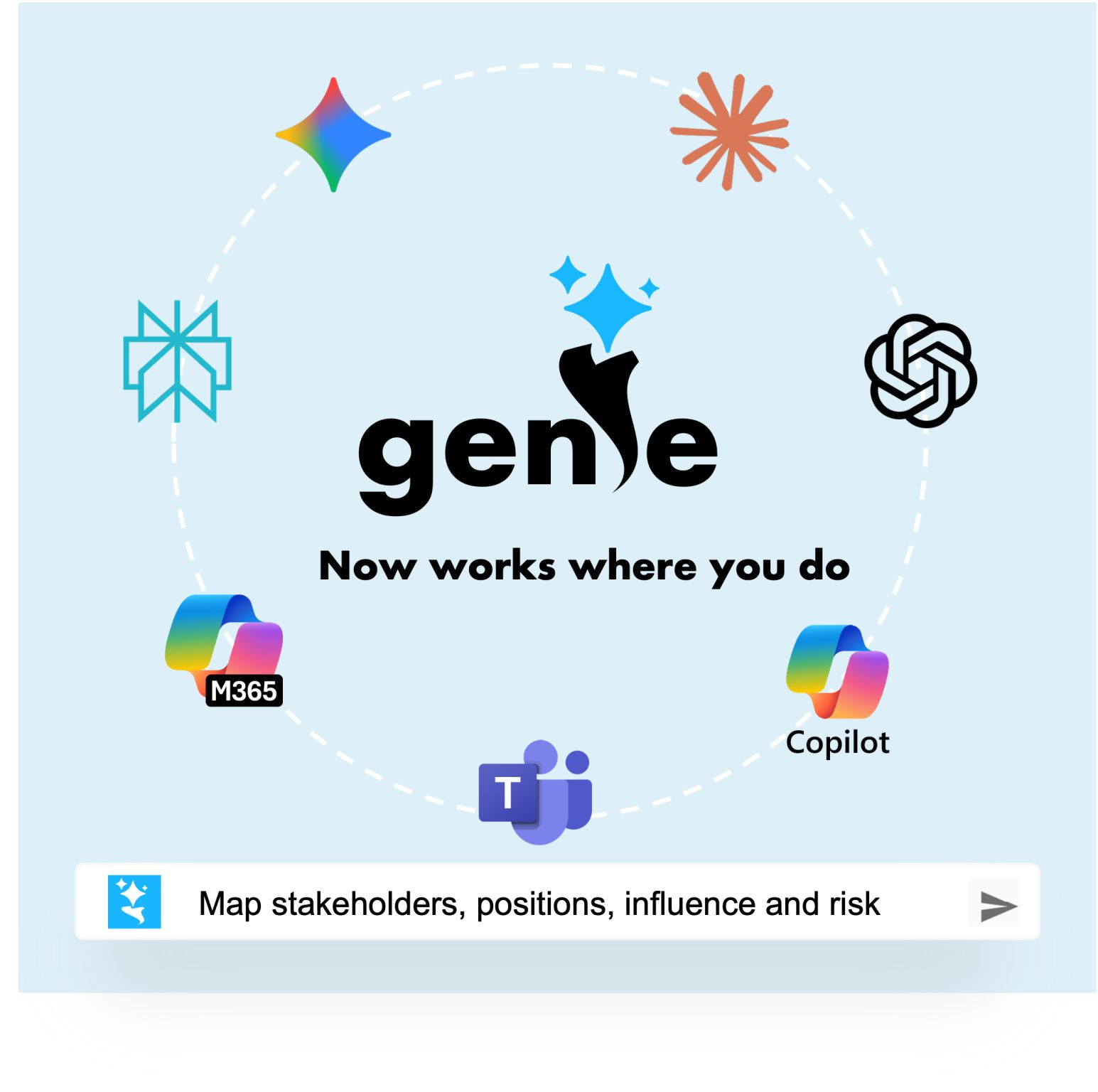
Enterprise AI must access trusted context without compromising governance. Organisations need control over data access, workspace isolation and permissions. Genie MCP enables this by connecting workspace intelligence to AI systems while preserving controls. This creates a secure foundation for expanding stakeholder intelligence, from reporting and advisory to workflow integration.
As enterprise AI evolves, its value will depend on the quality of intelligence it can access. Organisations that connect AI to structured, trusted context will gain the most. Genie MCP enables this by linking enterprise agents to stakeholder intelligence. Teams can better understand external change, preserve knowledge, prepare decision-makers and coordinate action.
Enterprise AI already helps organisations understand internal activity. With Genie, it can understand the stakeholder world outside and what to do next.



.png)
.png)
.png)