Genie for Risks Management

Anticipate risk before it materialises

Genie helps Risk teams move upstream in the risk lifecycle by continuously sensing external signals, understanding how risks form and escalate, and supporting leadership decisions before risks materialise into incidents.
Reduce exposure to emerging regulatory, reputational, and operational risk
Concentre a atenção nos riscos com maior probabilidade de escalar
Support faster, more defensible risk decisions
Why Risk teams need a new operating system
Risk functions are expected to anticipate what could materially impact the organisation - detect what is not yet obvious early.
The problem: Risk is often identified too late in the lifecycle
In many organisations, risks only become visible once they are already material:
  • When regulatory scrutiny intensifies
  • When narratives accelerate publicly
  • When stakeholders mobilise
  • When operational or reputational impact is already underway
This is a widespread timing and intelligence problem.
Most Risk teams still rely on:
  • Periodic risk assessments and static registers
  • Disconnected views of regulatory, reputational, geopolitical, and operational risk
  • Manual inputs and retrospective reporting
  • Limited visibility into early external signals and escalation dynamics
Risk management becomes reactive, and mitigation options narrow as urgency rises.
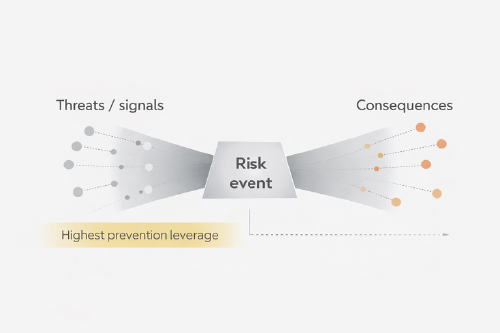
The risk lifecycle: early signals matter most
External risks rarely appear fully formed.

They begin as weak, fragmented signals - small regulatory moves, emerging narratives, shifts in stakeholder behaviour, abnormal activity patterns often across different markets and languages.
As attention builds:
  • Signals consolidate
  • Narratives harden
  • External actors amplify pressure
  • Response windows narrow

The greatest opportunity for risk reduction exists before risks are formally named.
What a modern Risk operating system enables
To operate earlier, Risk teams need more than frameworks and dashboards.
Geine provides the live external risk intelligence layer that continuously connects:
external signals ↔ issues ↔ stakeholders ↔ risk implications ↔ decisions
in a single, shared system.
This allows Risk teams to:

Core Capabilities for Risk Teams

1. External risk sensing & horizon scanning

Modern Risk teams require continuous visibility into external developments across regulation, public discourse, stakeholder behaviour, and market activity.

Effective teams maintain continuous awareness of policy developments, political signals, and narrative shifts across their priority themes and regions.

With Genie, you can:

  • Monitor external risk signals across issues, geographies, and languages
  • Detect abnormal patterns, targeted sentiment spikes, and early escalation signals
  • Identify emerging risks before they enter formal registers

Explore issue intelligence here.

2. Risk contextualisation & prioritisation

Determine which emerging risks are material and when they require action.

Risk teams are exposed to a constant flow of external signals. Distinguishing early indicators of material risk from background noise becomes integral.

With Genie, you can:

  • Monitor external risks with a context-aware system that surfaces related issues
  • Aggregate related external signals into coherent risk themes aligned to enterprise risk categories
  • Assess how risks are evolving, including the pace of escalation and direction of travel
  • Prioritise risks based on materiality, escalation velocity, and potential impact on the organisation

Explore stakeholder intelligence here.

3. Stakeholder-driven risk intelligence

Many enterprise risks are shaped or accelerated by external actors such as regulators, competitors, suppliers, clients, media, and advocacy groups.

Public Affairs effectiveness depends not only on who you engage, but how, when, and in what sequence.High-performing teams treat stakeholder engagement as a strategic discipline.

With Genie, you can:

  • Uncover relationships, affiliations, and influence pathways
  • Generate engagement insights and recommendations based on context and latest media signals
  • Build institutional memory; track interactions, and planning across teams

Explore stakeholder engagement here.

4. Decision-grade reporting & executive insight

Turn complexity into clarity with an AI-augmented workflow.

Public Affairs teams are routinely asked to brief leadership on complex, fast-moving external developments.

It’s pertinent to synthesise information into clear implications and recommended actions.

With Genie, you can automatically generate synthesised insights based on your business objective, stakeholders' engagement history, and media insights - thereby eliminating 70% of the workload.

Explore insight here.

Use Cases

Using Genie in different scenarios

Scenario 1 - Scenario-based risk planning grounded in real signals

Context: Risk teams need to stress-test response plans against realistic external developments

What Risk Teams do:

  • Explore “what-if” scenarios to test preparedness and response options
  • Assess how risks could evolve under different external conditions
  • Validate whether existing mitigations remain effective

How Genie supports this:

  • Injects live external signals and trends across KRIs, geographies, and entities
  • Grounds scenario planning in real-world developments, not static assumptions
  • Enables scenarios to be revisited dynamically as external conditions change

Output:

Scenario planning becomes adaptive, defensible, and aligned to actual risk trajectories.

Scenario 2 - Early-warning and predictive risk monitoring

Context: Risk teams need to identify rising exposure before incidents occur not after indicators breach formal thresholds.

What Risk Teams do:

  • Monitor how risks are trending over time
  • Identify acceleration in frequency, sentiment, or attention
  • Flag early warning signals to leadership

How Genie supports this:

  • Tracks trend acceleration, issue frequency, and sentiment shifts
  • Identifies emerging risk patterns across markets and domains
  • Provides credible early warning without relying on speculative forecasting

Output:

Risk teams gain earlier visibility and more time to act.

Scenario 3 - Supporting leadership during rapid risk escalation

An issue spikes unexpectedly, triggering concern from leadership, Legal, or Communications.

What Risk Teams do:

  • Consolidate signals and narratives
  • Assess speed, direction and potential impact
  • Provide clear options, trade-offs and next steps

How Genie supports this:

  • Narrative tracker that shows a summary of an issue, and negative sentiment spikes
  • Ask Genie pull data across stakeholders, engagement logs, external signals and customised trained datasets to give insights and recommendations on next steps to take

Output:

Leadership responds with clarity rather than urgency-driven reaction.

Detect emerging risks before they escalate. Early signals matter most.

Book a Briefing